
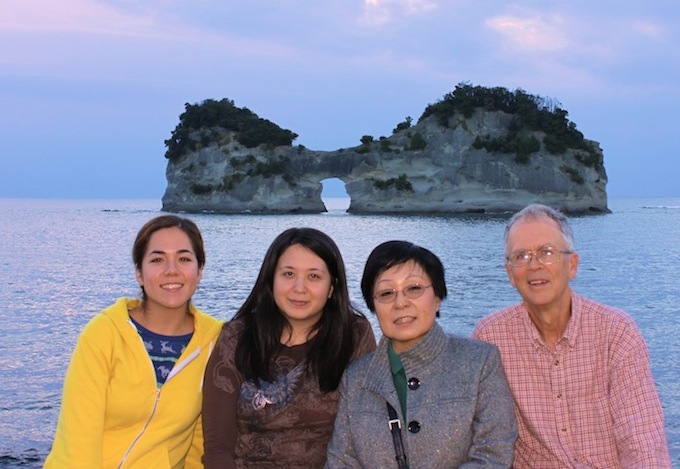
The Mission Activities of Tim and Yuko (Juji) Boyle, June 2007 update

Both the United Methodist Church and the Presbyterian Church (USA) support missionaries in many different countries, and each has a unique work that he or she is doing in the name of Christ. This is because each missionary's talents and abilities are different, and the needs of each country are so different.

Being a missionary in a highly developed, rich country like Japan is quite different from being a missionary in a poor country where people's physical needs are so desperate. Here in Japan, our ministries are not geared to helping the Japanese to grow enough food to keep from starving or anything else like that. Instead, the needs we try to meet are mostly spiritual in nature, as we help the Church in Japan to witness to Christ in a way that the Japanese can understand. This means not only telling them about Jesus in the Japanese language, but also formulating the message in the context of Japanese culture. For instance, telling them that they are "sinners" who need "forgiveness" simply using the Japanese words that normally are used to translate those English words will likely not communicate the intended message. This is because they use the same word "tsumi" for both "sin" and "crime", and "yurushi" for both "forgiveness" and "permission". Thus, a typical Japanese will likely perceive a "sinner" oriented message as irrelevant since he's not a "criminal". Also, "forgiveness of sins" could even be interpreted as "permission for crimes"! Likewise, there are many other ways the message must be adapted to really be understood and seen as truly "Good News". Even within Japan, however, the work various missionaries do may be quite different from one another. Many missionaries in Japan work as teachers in church related schools, but our work is different from that.

We came to Japan under the present joint appointment with the United Methodist Church and the Presbyterian Church (USA) in 1982. Tim served as the pastor of a small rural church on the northern island of Hokkaido until 1986, when we moved to our present location in Tsukuba Science City just north of Tokyo. We run a community center in this new, developing city with a variety of ministries for both the Japanese community and the growing international community. And we also serve the Japanese churches of the United Church of Christ in Japan (referred to as the "Kyodan" in Japanese and which includes both the United Methodist Church and the Presbyterian Church (USA) along with several other denominations) in the Ibaraki sub-district and throughout the Kanto area.

First, a little bit about the Tsukuba Christian Center and the community we work in. Tsukuba Science City is a planned city build during the last 35 years by the Japanese government centering around a major university and numerous scientific research centers. There are over 50 government-run research centers and many more run by private companies, making Tsukuba the science and technology center of Japan. Already, about 7000 foreigners from all over the world live and work in Tsukuba at any one time (the turnover is rapid), and so there are many needs among the foreign community that we try to address. Most of this work is done in English, as most of the people from overseas speak English. When we work with people from Korea and China, however, we often switch to Japanese, as researchers coming here generally must be fairly fluent in Japanese if they are not fluent in English.

For the English speaking community, we hold regular English language worship services and Bible studies, in addition to translating the Japanese service into English. At the once-a-month English service, we usually have about 12 to 20 people from all over the world (we have had people at one time or another from about 50 different countries!), and there are usually about 4 to 8 at the weekly Tuesday evening English Bible study. We help such people with a variety of problems, and bring them the good news of God's love through joint activities as well as individual counseling. One big project we have been working on for the whole international community is to help get an international school functioning in Tsukuba. Tim heads up the committee for that, and the fledgling Tsukuba International School is now finishing its 15th year.

Recently, a large group of Indonesians working in factories has asked us to help them establish a church, and so we have been able to help them locate a building in which as many as 300 of them gather weekly. Tim has preached there in English, with his message being translated into Indonesian, and we are helping them get established in a variety of ways. This is just another example of the internationalization going on in the world. In the future, this church wants to become a Kyodan church itself, which would make it only the second non-Japanese speaking Kyodan church in Japan. Four years ago, Tim was part of an official delegation to Indonesia to foster church-to-church relations, and an official cooperative relationship between the two churches is now being formalized. There is also a large Filipino community with many of the workers likewise being “undocumented aliens”, and so one developing area of our work has been in helping these communities network together to work on common goals. Japanese society desperately needs the labor of these people, but laws concerning the legal status and working conditions of these people are woefully inadequate and in need of reform.

Our basic calling to Japan, of course, is to work with Japanese Christians to help in winning their own people to Christ. We do this in a variety of ways including giving sermons and occasional seminars in local churches. Tim is sometimes asked to give presentations on the cults, particularly the Moonies, the Mormons, and the Jehovah's Witnesses, which are very active in Japan. We have, in fact, put out pamphlets in Japanese designed to educate people about the true teachings of these cults.

We are able to make many fruitful contacts in the local community. Tim is frequently asked to be the "foreign community representative" in numerous civic functions and Juji has particularly close ties with the medical community. In fact, as Juji has had to spend so much time in the hospital with her own health problems, she has also developed an important hospital ministry, often counseling other patients and giving them the kind of understanding and support that only a fellow patient can. In addition to helping with preparations for the various events of the Tsukuba Christian Center, this area of patient counseling her main ministry. One family, whose daughter had terminal cancer, came to faith in Christ as a result of Juji’s counseling, and are now active members in the Tsukuba Church. Several others have likewise accepted Christ, while others attend special events of the church as a direct result of her efforts.

Tim also teaches English classes to Japanese scientists at Tsukuba Center for Institutes, and while no direct evangelism takes place in such a setting as that, students are invited to come to church. A number of such contacts as these are now connected with the church here or elsewhere. We also put out a monthly English language newspaper of news about Tsukuba, and Tim's book (in Japanese) on the gospel message hidden in Japanese (Chinese) characters came out in 1994 and was in bookstores all over Japan. The English version was released in 2001 under the title, "Bible Stories Hidden In Chinese Characters," and a reprint of the Japanese came out in 2006.

Another very important part of our work — especially being in the Science City — is bringing together the worlds of Christian faith and modern science. Tim frequently does seminars in Japanese and English on the subject, and we work closely with a ministry in the U.S. founded by a Christian astronomer, Dr. Hugh Ross, in trying to advance the gospel by presenting the overwhelming evidence of divine design in the universe. "Reasons To Believe", headquartered in Pasadena, Ca., is dedicated to answering the doubts of skeptics while strengthening the faith of believers through the world of science. We are heading up an effort to put these materials in Japanese and reach particularly Japanese with a scientific background or interest through this particular tool. So far we have published three books, two pamphlets and two videos in Japanese, and other translations are being considered. Tim has also been Dr. Ross' translator on 6 speaking tours of Japan as well as giving seminars of his own.

Another project Tim has helped get off the ground is the Japanese branch of the Make-A-Wish Foundation, an organization dedicated to giving children with life-threatening diseases and their families a ray of hope and happiness by granting them a wish. Tim serves on the Board of Directors and handles communications with the parent organization, Make-A-Wish Foundation International.

Our ministry will be undergoing considerable change in the fall of 2007, when we move to new assignments in the Kobe-Osaka area. Tim will be assigned to the Buraku Liberation Center, which focuses on discrimination issues among the "burakumin", a group of Japanese with a history somewhat like the "Dahlit" outcastes of India and who still face various forms of unjust discrimination. Juji will be assigned to a counseling ministry in Kobe affiliated with a church-run nursing home for the elderly.

Our older daughter Lisa (27) finished a graduate school degree in Oriental medicine in 2006, and is beginning her career in acupuncture in 2007. She has been studying Chinese (which her total fluency in Japanese makes much easier). Jennifer (23) graduated from Biola University in 2006, where she majored in intercultural studies. She hopes to serve in youth ministry here in Japan in the future.

We hope that this gives you an idea of what our work is like. The life of a missionary can be very difficult, as it is not easy to learn a different language and culture and to be so far away from home. But if God calls you to be a missionary, it is one of the most challenging and exciting kinds of work to do. We would encourage you to see if God is calling you to become a missionary someday too. Even if God's plan for your life is not going overseas to a different culture as a missionary, you are still a very important part of God's witness to the world. You can be involved in mission outreach right in your own community, and at the same time, your prayers and financial support are what makes it possible for those God has called to be cross-cultural missionaries to fulfill that calling.

Updated: 2008 年 01 月 03 日,12:50 午後

アップロード 編集